We’ve all heard of autonomous trucks. For many, the first thought is that they belong in a distant, futuristic world. In reality, the technology has moved beyond research labs and into carefully controlled real-world trials. Fleets are already familiar with AI-powered cameras, telematics, and ADAS systems, which help drivers stay safer, improve consistency, and prevent accidents before they happen.
Building on these tools, programmes now underway in Spain, Germany, and China are exploring how the latest developments in autonomous trucks can support drivers on long routes, optimize efficiency, and maintain reliable journeys — all with experienced drivers still in the cab, ensuring operations run safely and as planned.
Understanding the 5 autonomy levels
The Society of Automotive Engineers defines six levels of vehicle automation. Here’s a breakdown, with a focus on what each level means for drivers and fleets:
- Level 1 – Driver assistance: the truck helps with a single task, such as adaptive cruise control or lane keeping. The driver remains fully in control.
- Level 2 – Partial automation: steering and speed can be managed together, but the driver supervises at all times.
- Level 3 – Conditional automation: the truck can handle specific driving conditions, but the driver is ready to take control if necessary.
- Level 4 – High automation: the vehicle can operate independently within predefined zones, such as geofenced highways or urban routes. A human driver remains present to monitor and manage unexpected situations.
- Level 5 – Full automation: fully autonomous anywhere, anytime — no human intervention required.
Even at Level 4, human expertise is central. Autonomous systems enhance decision-making, reduce fatigue, and provide real-time insights, complementing the skills and judgment of professional drivers.
A global perspective
Level 4 autonomous trucks are being trialed in multiple regions. A high-profile example comes from IVECO and PlusAI in Spain, where heavy-duty trucks operate along a 300 km freight corridor between Madrid and Zaragoza. Safety drivers remain on board, providing oversight while the trucks manage routine driving tasks. This trial demonstrates how autonomous systems can support drivers, improve consistency, and gather valuable operational data.
While you may have seen videos of trucks driving long distances with no one in the cab, these are typically highly controlled tests or demonstrations. On public roads, safety drivers are still present in almost all Level 4 trials, ensuring oversight and intervention if needed.
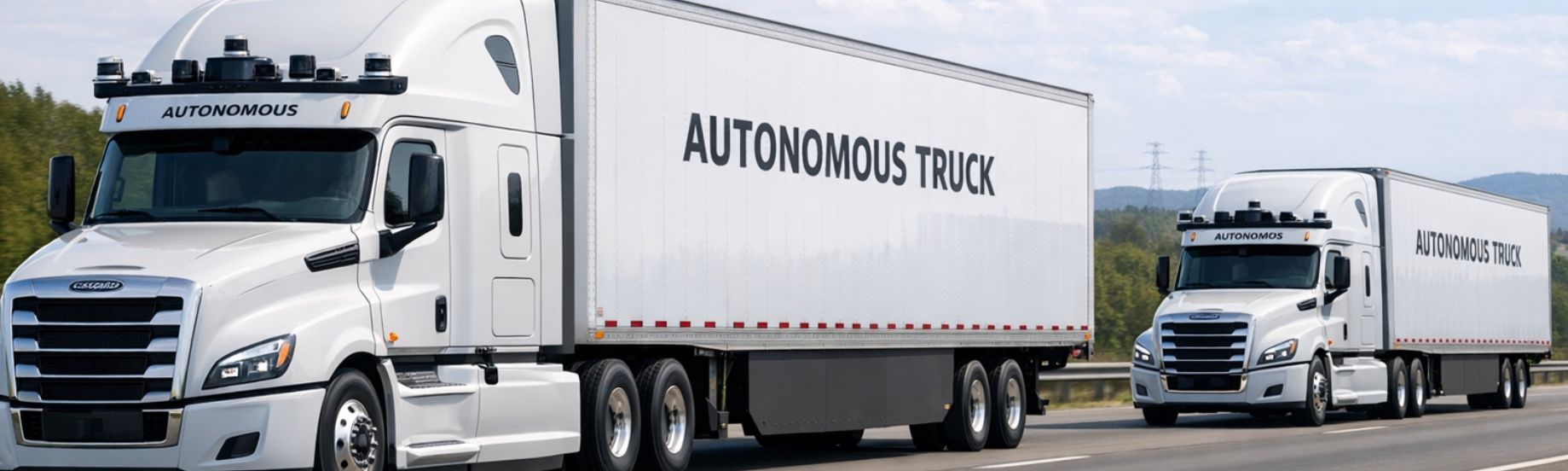
Other international examples include notable Level 4 trials in China and Germany. In China, companies like Pony.ai are testing autonomous truck platoons on cross‑provincial highways, where a lead truck with a safety driver guides multiple autonomous trucks in a coordinated platoon. These follow vehicles mirror the lead truck’s speed, braking, and steering inputs. Each follow vehicle is a complete, self-powered truck with its own sensors, cameras, and autonomous control systems, but it relies on the lead truck for coordination.
These trucks have already logged thousands of miles transporting real freight under controlled conditions, showing how autonomy can work alongside skilled drivers. Developers such as Inceptio Technology are building extensive real-world datasets from their Level 4 trials, helping refine systems while maintaining human oversight.
In Germany, the multi-partner ATLAS‑L4 project has run extensive motorway trials with safety drivers on board, demonstrating how autonomous systems can support consistent, safe driving on long routes. Authorizations from the German transport authority are expanding opportunities for real-world testing, providing fleets with valuable insights into how Level 4 automation could complement drivers in operational settings.
Autonomous freight testing is also active in the U.S. Texas has become a hub for trials, with companies like Torc Robotics, Aurora, Plus, and others running hub-to-hub operations and technology validation programs with safety drivers on board. These tests show that Level 4 systems can handle routine highway tasks while keeping human oversight central, highlighting how autonomy is being carefully introduced across multiple markets.
Across all regions — Spain, China, Germany, and the U.S. — these examples show that autonomous trucking is a carefully managed evolution. Technology is not replacing drivers; it’s supporting them, helping maintain efficiency, consistency, and safety while allowing drivers to focus on higher-level oversight and decision-making.
What this means for fleets
Autonomous systems help reduce human-error risks, particularly on long or repetitive routes. By handling routine driving tasks, Level 4 trucks act as a co-pilot, giving drivers better situational awareness and guidance when navigating complex traffic conditions. This can improve both road safety and driver confidence.
Early studies show autonomous assistance can improve fuel efficiency by around 11 %, with higher gains in specific scenarios. This helps fleets reduce costs and cut emissions, supporting both operational efficiency and sustainability goals. Systems like advanced sensors and AI monitoring can also achieve lane detection accuracy above 99 %, further enhancing safety and operational performance.
Understanding Operational Design Domains — the geofenced areas where autonomous systems operate safely — helps fleets plan for integration. Observing trials and studying performance data allows fleets to see how these systems can support drivers without disrupting established workflows.
Will autonomous trucks replace drivers?
That’s the million-dollar question — and the honest answer is that it remains to be seen. The majority of Level 4 trials still include a trained safety driver in the cab, ensuring oversight while the truck handles routine tasks. Industry experts emphasize that these systems are designed to support and enhance driver capabilities, not remove them.
Autonomous technology can take on repetitive tasks like maintaining speed, lane keeping, and optimized route management, allowing drivers to focus on situational awareness, decision-making, and exception handling.
The broader picture is that driver roles will evolve rather than disappear. While Level 4 trials demonstrate that trucks can handle long, controlled motorway routes, navigating tight urban streets, rural roads, or complex local deliveries remains firmly a driver’s responsibility.
Autonomy takes on predictable tasks, letting drivers focus on logistics oversight, safety management, and higher-value responsibilities. In our eyes, the human element is still key — particularly in rural locations — but you never know what the future holds.
The road ahead for autonomous freight
Market analysts predict the global autonomous trucking sector could reach $616 billion by 2035, highlighting the growing importance of this technology for fleets, drivers, and the wider transport ecosystem. Public perception studies show that nearly half of respondents believe autonomous trucks could improve traffic flow, though safety concerns remain for many. Careful, gradual integration alongside skilled drivers will be key.
All of this remains to be seen, but it’s a development we’ll be watching closely.
Autonomous trucks may still be in trials, but AI-powered cameras are already improving fleet safety, preventing accidents and keeping drivers, and all road users safe. Talk to our team to see how.