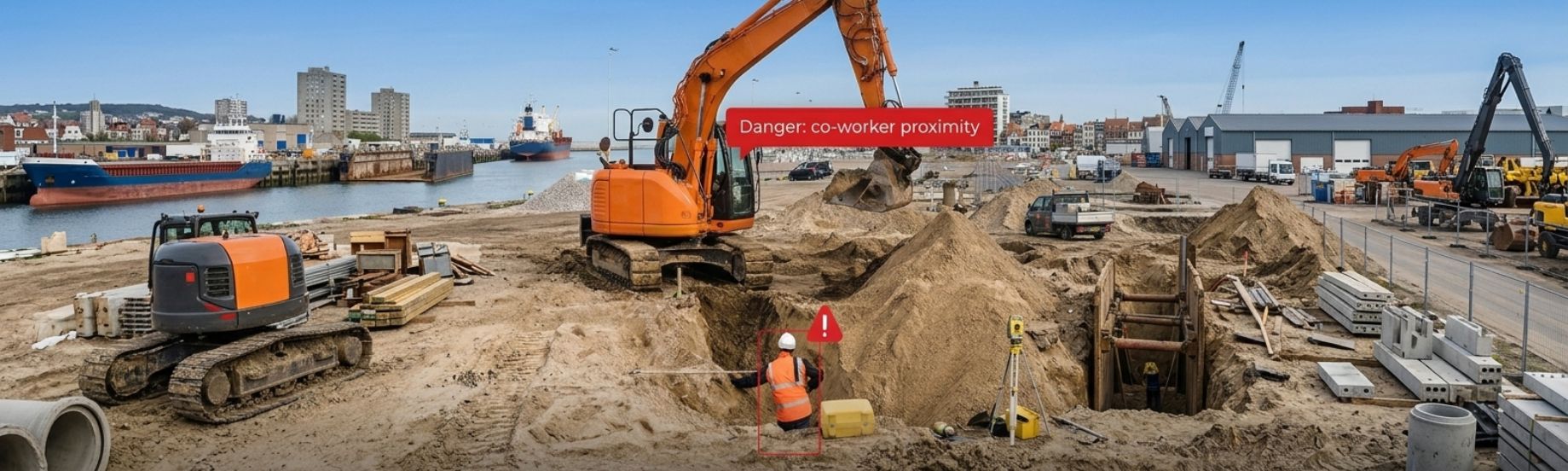
Construction fleet safety: from incident reporting to real-time prevention

Construction fleet safety no longer starts after an incident happens — it predicts it, and prevents it. On constantly changing worksites and public roads, identifying risk after the fact is already too late.

Posted 23 Apr 2026

Construction fleet safety is about identifying, managing, and reducing risk across vehicles operating on both public roads and active worksites. It focuses on driver behavior, vehicle movement, and operational context in environments where conditions change constantly and exposure to risk is high.

Unlike standard fleet safety models, construction fleet safety must work across mixed vehicle types, dynamic sites, and shared work zones — where a single unsafe maneuver can affect people, equipment, and project timelines in seconds.

Why construction fleet safety still fails — despite more data

Most construction organizations already collect large amounts of safety data. Telematics tracks location and speed. Incident reports record what went wrong. Coaching programmes aim to improve behavior.

Yet incidents and near‑misses still occur.

In the UK, construction remains the industry with the highest number of fatal workplace injuries, with vehicle‑related incidents among the leading causes — underlining a simple truth: more data on its own does not equal better prevention.

The problem isn’t visibility after the event. It’s timing.

Too often, risk is only identified during reviews and investigations, once the opportunity to intervene has already passed. Patterns emerge slowly, after incidents have already happened, instead of being recognized while work is underway.

This isn’t a failure of commitment to safety. It reflects the limits of approaches that rely on hindsight in fast‑moving, high‑risk environments.

Why construction sites amplify delayed risk

On a construction site, conditions rarely stay the same.

A telehandler might follow one safe route in the morning and a completely different one by the afternoon. Visibility changes with load height, temporary barriers, and ground conditions. Pedestrians, subcontractors, and machinery move continuously through shared spaces.

If a near‑miss occurs, it often only comes to light later in a review. By then, the same maneuver may already have been repeated multiple times — across different sites and under similar conditions.

And in construction, even small incidents don’t stay small. A single vehicle issue can delay dependent trades, force crews to be rescheduled, and ripple across project timelines.

Because construction activity is tightly sequenced, traditional safety processes — fixed rules, post‑incident reviews, and periodic training — struggle to keep pace with environments where risk is constantly changing.

That’s why improving fleet safety in construction can’t rely solely on documenting what went wrong. It requires visibility into what’s happening as work is carried out, while there’s still time to act.

Learn more about how we support construction operators across vehicles, sites, and changing work environments on our construction industry page.


What construction fleets need to manage risk earlier

Reducing incidents in construction isn’t about adding more reports. It requires a shift in how risk is handled.

Effective construction fleet safety depends on:

  • Seeing risk as it happens, not days later in reports
  • Responding to unsafe driver behavior in the moment
  • Spotting early warning signs such as near misses, blind spot interactions, and people working close to vehicles or machinery
  • Applying a consistent, company wide coaching approach so risks identified on one site aren’t repeated elsewhere

This treats safety as a live operational process. Near‑misses, poor visibility, fatigue, distraction, and rushed movements become early indicators to act on — not events to explain away after the fact.

How CameraMatics enables a prevention‑first approach

This prevention‑first model sits at the core of how CameraMatics supports construction fleet safety.

By combining real‑time vehicle data with AI‑powered video intelligence, CameraMatics surfaces risk while work is actively taking place. Drivers and operators receive real‑time alerts when unsafe situations arise, and every event is automatically captured for review and coaching.

This enables organizations to:

  • Identify unsafe behavior and hazardous situations early
  • Intervene before incidents lead to injury or vehicle downtime
  • Apply consistent safety standards across changing sites
  • Turn risky events into learning opportunities across the business

Instead of reacting to isolated incidents, safety becomes something that is actively managed as part of day‑to‑day operations.

Proof that prevention‑led safety works

Organizativos that adopt this approach see safety shift from a reactive process to a controlled, repeatable discipline.

AI‑powered video telematics replaces assumption with clarity. Behavior‑based coaching becomes targeted rather than generic. Near‑misses are treated as signals to learn from, not warnings ignored until something goes wrong.

These gains are driven by better understanding — not enforcement — of how vehicles, people, and active sites interact in real operating conditions.

“An unsafe contractor cannot be successful in this industry. CameraMatics are helping us take our safety culture to another level.”

John Steven Phillips, President & CEO, C.W. Wright Construction

From reactive safety to real‑time prevention

When safety becomes proactive, the most immediate result is fewer incidents and accidents.

By identifying risk earlier and intervening sooner, organizations can prevent collisions, injuries, and near‑misses before they occur. That prevention also reduces unplanned downtime, shortens claims resolution, and brings greater consistency to how vehicles are operated across sites.

The result is safer work, less disruption, and more predictable delivery — even in complex, fast‑changing construction environments.

Prevention‑led safety also supports efficiency, utilization, and sustainability across construction operations.

Conclusion: the shift the construction industry must make

Construction fleet safety doesn’t fail because people don’t care or don’t understand the risks. It fails when those risks only become visible once it’s too late to act.

The organizations leading the way are moving beyond incident reporting and towards real‑time risk visibility. By combining live insight, behavioral understanding, and fleet‑wide learning, they prevent incidents rather than simply responding to them.

This shift — from reacting after the fact to preventing risk in the moment — is defining the next standard for construction fleet safety at scale.

For a deeper breakdown of how leading construction organizations are reducing incidents and operating more efficiently