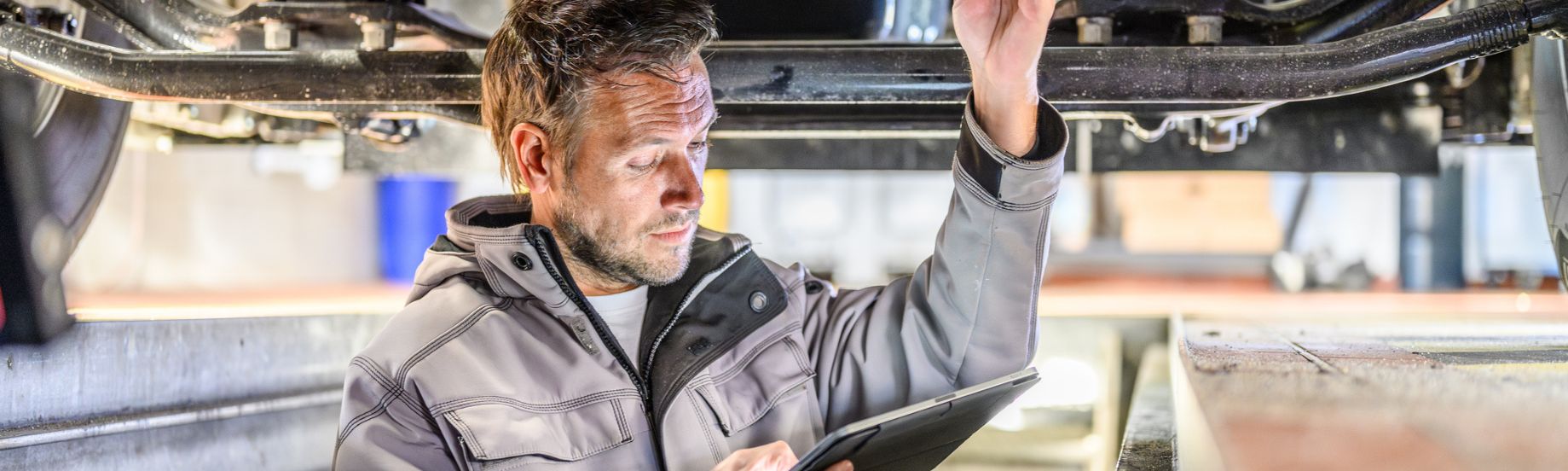
When a single vehicle in your fleet suffers an unexpected breakdown, it sets off a chain reaction across your entire operation — deliveries are delayed, customers are disappointed, and the ripple is felt by everyone on your team. On top of that comes the financial hit of repairs – assuming the vehicle can be fixed – adding stress and uncertainty to an already challenging situation.
Predictive maintenance software — powered by in-depth telematics data — prevents this from happening. It acts like an early warning system for your fleet, identifying potential issues before they lead to costly breakdowns.
What is predictive maintenance?
Predictive maintenance is a smarter, data-driven way of looking after your vehicles.
Instead of waiting for something to break – or carrying out routine maintenance just because the calendar says it’s due – predictive maintenance collects extensive vehicle data to predict failures.
AI analyses things like engine performance, fault codes, temperature changes, tyre pressure, battery health, driving patterns, and overall vehicle condition patterns across the entire fleet to identify what caused breakdowns in the past, alerting the manager in real-time about potential issues weeks before they happen.
In simple terms it tells you what needs attention, when it needs attention, and why – so you can proactively prevent breakdowns instead of reacting to them after the fact.
Predictive maintenance vs preventative maintenance
Now that we’ve looked at what predictive maintenance actually does, it’s important to understand how it differs from the more traditional approach most fleets still rely on: preventative maintenance.
Preventative maintenance is based on routine.
You service a vehicle because it has hit a certain mileage or a date on the calendar — not because the vehicle itself is showing signs of wear. It’s structured and familiar, but it has limitations:
- It treats every vehicle the same, even if they’re used very differently
- Problems that appear between scheduled services can still lead to unexpected breakdowns
- You often end up over-servicing some vehicles and under-servicing others
In other words, preventative maintenance keeps your fleet organised, but not necessarily protected.
Predictive maintenance, by contrast, responds to what’s actually happening inside each vehicle in real time.
Instead of relying on fixed schedules, you maintain vehicles based on their true condition — backed by data from sensors, diagnostics, and telematics.
This means you can:
- Catch faults early, before they become costly failures
- Carry out maintenance only when it’s genuinely needed
- Reduce downtime with fewer unexpected breakdowns
- Extend vehicle lifespan through early detection of issues
- Improve safety and reliability across the entire fleet
Where preventative maintenance helps you stay on top of routine tasks, predictive maintenance helps you stay ahead of risk.
Preventative maintenance follows a schedule. Predictive maintenance follows the data.
How to implement predictive maintenance
Implementing predictive maintenance starts with equipping your fleet with the right tools — systems that give real-time visibility into vehicle health, monitoring engine performance, fault codes, battery status, tyre pressure, and more, so potential issues are flagged early.
Next, set up alerts and automated maintenance workflows. With CameraMatics and Geotab, we can generate work orders automatically, schedule repairs, and track recurring issues — all before a breakdown occurs. This removes the need for manual maintenance requests, ensures critical tasks are prioritised based on risk, and lets your team act on data from the vehicle.
Finally, integrate this into daily operations. Make sure your team knows how to respond to alerts, log completed maintenance, and use the insights to continuously improve vehicle reliability and efficiency.
If you haven’t already got predictive maintenance software in place, CameraMatics can help you implement the right solution for your fleet.
Benefits of predictive maintenance
Financial peace of mind
Unexpected breakdowns don’t just take a vehicle off the road — they ripple through your whole operation. Every day a vehicle sits idle costs money, pushes back schedules, and puts stress on your team.
Based on published fleet-industry reports, the numbers are clear: downtime for a commercial truck costs approximately £600 per day, with unplanned repairs usually taking 1–3 days. Factor in the £4,000 average repair cost, and a single breakdown can end up costing businesses nearly £6,000.
Now scale that across a fleet of 50 vehicles — if just five break down over the course of a year, that’s nearly £30,000 in losses, and those figures sit firmly at the low end of industry estimates.
And it’s not just the breakdown itself — vehicles often run below peak efficiency before a failure, consuming more fuel and costing more money.
Predictive maintenance changes all that: it spots these issues early, preventing them from escalating into costly problems. The result? Vehicles stay on the road, schedules stay on track, and your team can focus on running the business instead of reacting to breakdowns.
Regulation and compliance
Keeping up with legal requirements is a constant challenge for fleets. Predictive maintenance helps you stay audit-ready and compliant. In the U.S., this includes CVSA inspections and pre-trip/post-trip vehicle checks.
In the UK, operators must meet MOT, DVSA, and periodic roadworthiness checks. By monitoring key vehicle metrics like brakes, tyres, lighting, and engine health, predictive maintenance ensures your fleet is always inspection-ready, helping you avoid penalties and downtime.
Operational efficiency
Predictive maintenance keeps your fleet moving smoothly. It lets you schedule maintenance around actual vehicle use, spot recurring issues before they escalate, and use telematics data to prioritise repairs, allocate resources, and monitor vehicle health across your entire operation.
Safety on the road
A vehicle in top condition is a safer vehicle. Predictive maintenance reduces the risk of accidents caused by mechanical failure, while real-time alerts give drivers and operators visibility of potential hazards before they become critical.
It also supports driver coaching: monitoring patterns like hard braking, sharp turns, and rapid acceleration highlights risky behavior and informs targeted training, keeping drivers and everyone on the road safer.
Environmental impact
Keeping vehicles running efficiently also helps the planet. Well-maintained engines burn less fuel, producing fewer emissions, and timely component replacement reduces waste. Over time, a fleet that is monitored and maintained proactively operates cleaner and greener.
Strategic advantages
The benefits extend beyond the nuts and bolts. Fewer breakdowns mean your fleet delivers on time, improving customer trust and satisfaction.
Predictive maintenance helps make costs predictable, giving operators the confidence to plan budgets and resources effectively. And because the data scales across the fleet, it provides insights for smarter decision-making as your operation grows.
The future of predictive maintenance
We’ve already come a long way. Today, predictive maintenance helps fleets stay ahead of breakdowns, optimises maintenance schedules down to individual vehicles, and keeps operations running more efficiently, safely, and reliably than ever before. But the technology isn’t standing still.
The next wave of predictive maintenance will be smarter, faster, and even more proactive. Advanced AI and sensor networks will spot potential issues earlier, while edge computing will allow vehicles to analyse data instantly, right on the device. Digital twins — virtual replicas of your fleet — will let operators simulate scenarios, test maintenance strategies, and plan repairs before problems even appear. Even new AI approaches like federated learning will provide sharper predictions while keeping sensitive data secure.
As predictive maintenance becomes smarter and more integrated, fleets that haven’t adopted it are already at a disadvantage. Don’t get left behind. Talk to us today.