If your business has vehicles on the move, you already know how difficult the fuel crisis has become. Diesel prices are volatile, margins are shrinking, and pressure is mounting. Fuel has always been a major operational cost, but today it’s a defining factor in fleet profitability — and even long-term viability.
But all is not lost. Fleet operators often underestimate just how much fuel is being wasted through everyday inefficiencies. Harsh driving habits, wasted miles from poor routing, or idling vehicles can quietly cost businesses thousands each year.
With modern telematics and real-time visibility, you can actually see exactly where fuel is being wasted, understand why it’s happening, and take practical steps to stop it.
Fuel costs in the USA
Here’s some perspective, with real numbers. According to the US Bureau of Transportation Statistics, a semi-truck in a typical transportation company might cover 100,000 miles in a year using roughly 10,000 gallons of diesel.
With the current average diesel price at $5.07 per gallon, that adds up to about $50,700 per vehicle annually.
For a fleet of 200 trucks, that’s a total yearly fuel bill of roughly $10.14 million.
Even a modest 2% improvement in efficiency could save the fleet around $202,800 per year. And most estimates suggest that smarter driving behavior can reduce fuel use by 10–15%, unlocking $1.01–$1.52 million in annual savings.
Four ways your fleet can reduce fuel consumption
The causes of fuel waste are consistent across the industry. Fortunately, so are the solutions.
- Routing vehicles in the most efficient manner possible
- Driving at more efficient speeds (and avoiding truly excessive speeds)
- Avoiding harsh braking and acceleration as much as possible
- Reducing idling as much as possible
Smarter routing: the first step to lower fuel costs
The importance of efficient routing should be obvious. Vehicles moving backwards and forwards between jobs at random — or relying on a driver’s personal navigation — will cost you fuel and money. In 2026, there’s no excuse for this.
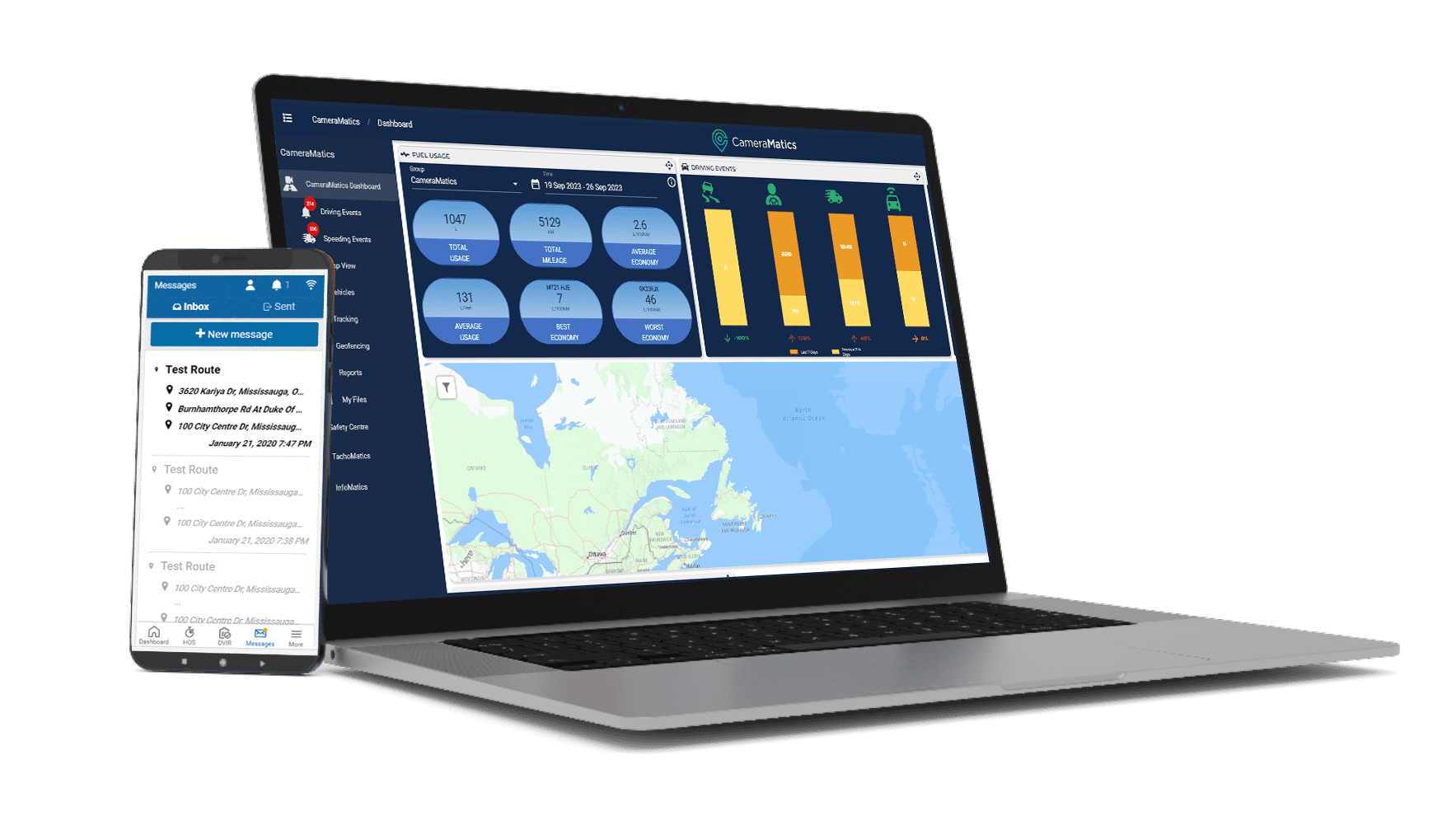
Geotab our global strategic partner enables automated, efficient routing, reducing fuel consumption as a result
The right system ensures every route and schedule is fully optimized and can even identify overlapping routes that could be simplified.
That includes the ability to change routes on the go as situations change, or identify which vehicle is best positioned to attend to a particular job at any moment in time.
Speed management: reducing excessive fuel burn
Encouraging drivers to stick to more efficient speeds can have a dramatic impact on fuel consumption. For example, the average semi-truck can use up to 40% more fuel when driven at 60 mph compared to 50 mph — and the higher the speed, the worse it gets.
Of course, there are times when higher speeds are necessary and legal. But in most cases, slowing down pays off.

Fortunately, solutions like CameraMatics can provide speeding alerts when drivers maintain speeds over thresholds set by the organization, which in turn enables driver education to be focused on real-life events rather than abstract guidelines about ‘best practice’.
Limiting harsh braking, rapid acceleration and idling time
The exact same logic applies to harsh braking, rapid acceleration, and idling. Idling, for example, can consume more than 0.264 gallons per hour. Let’s take a look at our numbers again:
0.264 gallons/hour × 1 hour/day × 250 days × 200 trucks ≈ 13,200 gallons/year
13,200 × $5.07 ≈ $66,900/year
Both behaviors can — and should — be detected by your telematics solution. Fleet managers can use this data to identify drivers who need targeted, personalized coaching.
Beyond driving behavior, a sudden drop in fuel efficiency for a particular vehicle may indicate maintenance is needed. Modern AI-powered telematics can even detect when maintenance is required by analyzing these numbers.
In all cases, the key is awareness: collecting the right data and continuously monitoring common issues can reveal where your fleet is using more fuel than it needs to.
The bottom line: data turns fuel savings into real, measurable ROI
The recurring theme here is data. Gathering it, and analyzing it, to ensure that your efforts to save fuel are targeted and effective.
And there’s no getting away from it, that means spending money on a sophisticated telematics system, and the time of a fleet manager to read that data and act upon it.
But even a serious telematics solution costs somewhere in the region of a dollar a day per vehicle, or 365 dollars a year. If you compare that to the numbers we looked at earlier, you’re looking at around 1% of the total fuel bill for a single vehicle. And that is before we think of all the other benefits that such a solution delivers.
With fuel prices becoming increasingly volatile, maximizing operational efficiency is critical to protecting your margins and keeping your trucks on the road.
Talk to our team about how data-driven telematics can deliver immediate savings across your fleet.


