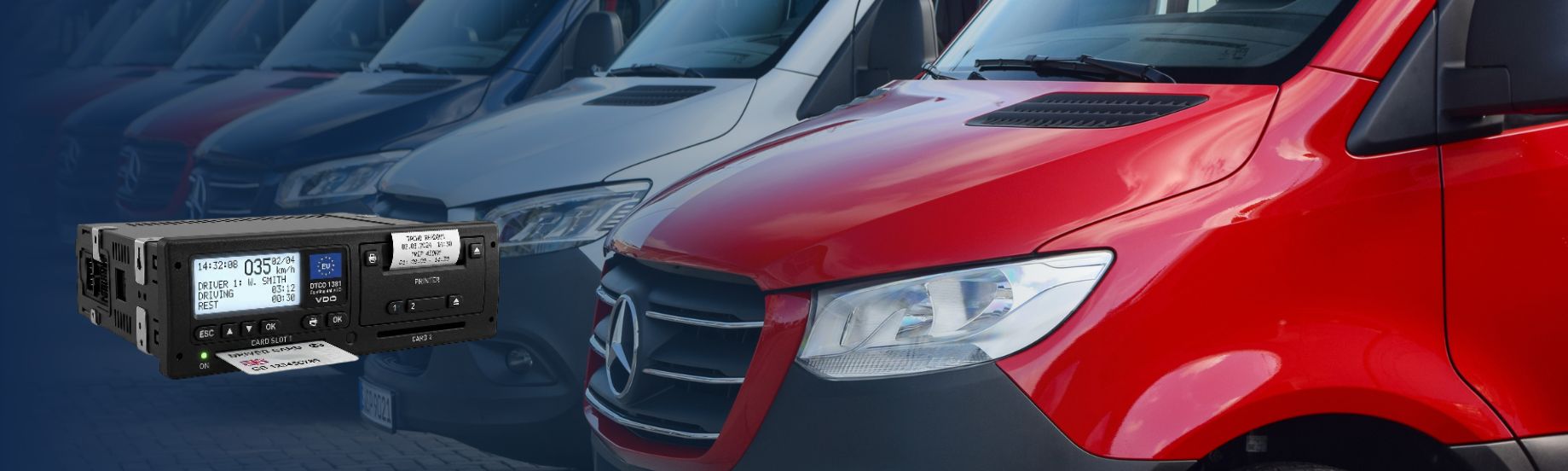
EU tachograph rules for vans: what’s changing in 2026

From July 2026, certain vans used in international transport across the EU will come under tachograph regulations for the first time. While the change is limited to specific operations, it introduces formal driver hours compliance for many van fleets for the first time.

Posted 27 Apr 2026

From July 2026, certain light commercial vehicles used in international transport within the EU will come under new tachograph compliance requirements. This applies to vans between 2.5 and 3.5 tonnes engaged in cross-border commercial operations, marking a notable change for affected fleets.

While tachographs have long been associated with HGV operations, this update extends existing EU drivers’ hours rules to a wider range of vans used in international transport. For fleet operators working across European borders, this represents a shift in how compliance and driver activity must be managed.

What are the new van tachograph rules in 2026?

From 1 July 2026, light commercial vehicles between 2.5 tonnes and 3.5 tonnes will require a smart tachograph when they are:

  • Operating international transport within the EU
  • Carrying goods commercially in international transport

In these cases, vehicles must be fitted with a second-generation smart tachograph (Smart Tacho 2 / G2V2).

This brings them under the scope of EU drivers’ hours regulations, including:

  • Maximum daily and weekly driving limits
  • Mandatory rest and break requirements
  • Digital recording of driving activity
  • Standard enforcement and compliance obligations

This change forms part of the EU Mobility Package and is designed to improve consistency in enforcement across commercial road transport.

What is a tachograph?

Some van operators may not be familiar with the term “tachograph”. A tachograph is a device used to record driving time, speed, and rest periods to ensure compliance with EU drivers’ hours regulations.

It has traditionally been used in HGV operations, but where vehicles fall within scope of EU regulations, it becomes a legal requirement regardless of vehicle type.

Who actually needs a tachograph in a van?

The requirement does not apply to all vans in this weight category. The requirement is determined by the nature of the journey and the vehicle’s Maximum Authorised Mass (MAM). A tachograph is required if:

  • The vehicle (or vehicle and trailer combination) has a MAM between 2.5 tonnes and 3.5 tonnes.
  • It is used for international transport within the EU or EEA.
  • It is engaged in commercial operations including hire and reward and own account operations
  • It is performing cabotage - domestic transport within an EU member state conducted by a non-resident operator.

A tachograph is not required if:

  • The vehicle operates exclusively within the UK (domestic-only transport).
  • Your business operations do not involve any international or cross border journeys.
  • It falls outside the scope of EU drivers’ hours regulations (e.g., specific exemptions for certain types of private or non-commercial transport).

Crucially, the trigger is the international nature of the journey. Whether your van is UK-registered or registered within an EU member state, if it crosses an international border for commercial purposes, these regulations apply.

How do drivers obtain a digital tachograph card?

In the UK and EU, digital tachograph cards are issued by the relevant national authorities and are required for drivers operating vehicles that fall within scope of EU drivers’ hours regulations.

For many van drivers, this may be the first time they encounter the process if their operations come into scope under the 2026 changes. The application process itself does not change, but the number of light commercial vehicle drivers requiring a card is expected to increase as the regulation expands.

Once issued, the card is used to record driving activity through the smart tachograph system, forming part of the vehicle’s compliance record.

Operational impact of van tachograph compliance

Where vehicles fall within scope, they must comply with the same drivers’ hours framework used in heavier commercial transport operations.

This introduces:

Drivers’ hours compliance

Drivers must follow regulated limits on driving time, breaks, and rest periods. This reduces flexibility in route planning and scheduling.

Mandatory recording

Driving activity must be recorded using a smart tachograph, creating a formal, auditable record of vehicle use.

Operational planning requirements

Routes and schedules must be planned with driving time compliance in mind, particularly for longer international journeys.

Increased compliance visibility

All recorded activity becomes auditable, increasing the importance of accurate data and structured fleet management processes.

Why this matters for fleet operators

While the regulation applies only to a specific category of international operations, the operational impact is significant for affected fleets.

Vans are widely used across sectors such as:

  • Cross-border logistics and delivery
  • Time-sensitive transport operations
  • Subcontracted international haulage
  • Scalable distribution and last-mile networks

For many operators, vans have provided a high level of flexibility compared to heavier commercial vehicles. The introduction of tachograph requirements reduces that flexibility and introduces more structured operational constraints.

The hidden challenge: visibility and control

A key challenge for many van fleets is not regulation itself, but visibility into day-to-day operations.

Compared to HGV operations, van fleets often have less structured visibility of day-to-day driver activity.

  • Limited real-time monitoring of driver activity
  • Fragmented compliance processes
  • Manual or reactive reporting systems
  • Inconsistent enforcement of internal policies

When tachograph regulation applies, driving activity becomes fully recorded and auditable. This increases the importance of having accurate systems in place to understand and manage fleet behaviour.

For many operators, the gap between assumed compliance and recorded activity becomes more visible under regulated conditions.

How fleet managers can prepare now

Although these requirements do not take effect until July 2026, fleets with any level of EU exposure should begin preparing now.

For some operators, the first step is simply understanding where exposure exists.

Assess international operations

Identify whether any vans are used, even occasionally, for EU cross-border transport.

Review compliance processes

Evaluate how driving time, scheduling, and operational oversight are currently managed across the fleet.

Improve visibility of fleet activity

If you only operate vans of this size, you may not previously have needed to think about regulated driving hours or what a tachograph is. However, understanding these systems becomes important once operations fall within scope.

Plan for system readiness

Consider how driving data, compliance records, and operational reporting will be managed as regulatory requirements increase.

In many cases, fleets discover gaps only when mapping current processes against regulatory expectations.

Where operators already use telematics platforms like CameraMatics, much of this transition can be supported through improved visibility of driver behaviour, journey data, and operational reporting, helping ensure compliance is based on accurate, real-time insight.

Final thoughts

The extension of tachograph requirements to certain vans marks a clear shift in how light commercial vehicles are regulated in international transport.

While the scope is limited to specific cross-border operations, the direction of travel is clear: increasing alignment between fleets of vans and established commercial vehicle compliance standards.

For operators, the key consideration is not only whether the regulation applies, but whether existing systems provide sufficient visibility and control to manage it effectively.

Those who prepare early will be best placed to maintain efficiency while adapting to a more structured compliance environment.

If these new regulations impact your operations, get in touch to see how CameraMatics can help.