Every day, commercial vehicles face a hidden threat: organized crash-for-cash gangs targeting fleets with staged accidents and bogus claims. Whether you delivers goods or services, these gangsters see commercial vehicles as easy targets — and one staged accident could cost your business tens of thousands.
These aren’t accidental bumps that get exaggerated later; these are planned attacks, designed to pin liability on your company because commercial vehicles are seen as being the most profitable.
And the financial fallout is mind blowing. The Coalition Against Insurance Fraud estimates that fraud costs the insurance industry over $80 billion every year. For fleet operators, it’s not just about rising premiums. A single false accusation can lead to a massive payout that could permanently shut your doors.
You can’t rely on luck or honest witnesses. You need solid, irrefutable evidence. And no one understands this better than fleet owners themselves – like Alan Honer.
“I won’t allow a single truck out of my yard unless it is protected by this technology. There are too many instances of trucks being falsely accused of causing a collision – accusations that can put a trucking company out of business. I’m confident CameraMatics will help me in any future events.”
Let’s take a look at the top five crash-for-cash scams targeting commercial vehicles — and how you can help to prevent them happening and protect your business.
1. The swoop and squat
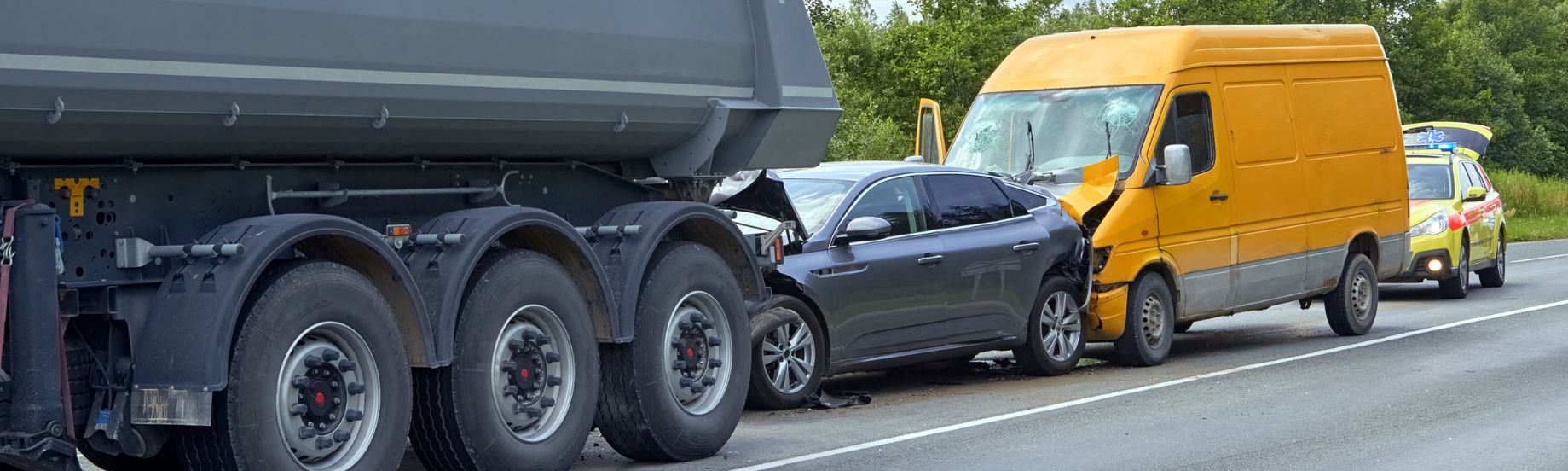
The swoop and squat is one of the most common — and most costly — crash-for-cash scams happening to commercial fleets around the world. Criminals orchestrate these scenarios using two cars to trap a truck: one abruptly brakes in front (the “squat” vehicle), while the other collides from behind (the “swoop” vehicle). Both then make false insurance claims for damages and injuries.
Trucks and commercial vehicles are particularly vulnerable because they often have extensive insurance coverage, making them lucrative targets. Fraudsters aim for higher payouts by claiming significant damage or personal injuries resulting from the staged accident.
2. The sideswipe at a junction
The sideswipe or lane-squeeze scam often occurs at roundabouts or multi-lane junctions. A fraudster waves your driver out, pretending to be courteous, then either collides with your vehicle or orchestrates a side impact mid-lane-change. False claims frequently include allegations of negligence, supported by staged “witness” accounts.
3. Brake-check staging
Similar to the swoop and squat, the brake-check scam is deceptively simple but highly effective. A vehicle in front repeatedly brakes to cause a collision. Without video evidence, insurers may assume your driver failed to maintain a safe stopping distance.
4. Courtesy wave / drive-down scam
The courtesy wave or drive-down scam is increasingly common in congested urban areas. A fraudster signals your driver to move forward, then accelerates into the rear of your vehicle and claims you failed to yield. Without clear evidence or witnesses, insurers may initially assign blame to your driver.
5. The phantom vehicle or hit-and-run
This is a claim alleging your driver fled the scene, often without any real collision having taken place. A claimant files a fraudulent insurance claim, alleging that your clearly identifiable commercial vehicle caused damage and then fled the scene. The incident is often entirely fabricated, forcing your company to prove that it didn’t happen.
Jump-in claims
Although not mentioned on the above list, it is worth mentioning Jump-in claims. These often occur alongside any fraudulent insurance claims when extra passengers suddenly appear claiming injury. Again, without proof, insurers may settle quickly, sometimes multiplying the payout 3–5x, significantly increasing the financial impact of even a minor incident.
The real impact of insurance fraud on fleets
For fleet operators, the consequences of a single successful fraudulent claim are immediate and real and impact the whole business:
- Operational disruption: Investigations, vehicle downtime, and repairs can throw delivery schedules off track and add hours of administrative work.
- Reputational damage: False accusations of negligence or fault can harm client relationships, undermine your safety record, and put critical contracts at risk.
- Financial strain: Beyond the claim itself, increased premiums, legal fees, and admin costs can be so severe they threaten even well-established fleets.
- Driver pressure: Drivers are left to defend themselves against professional criminals, adding huge amounts of stress and lowering morale.
If your fleet hasn’t been targeted yet, count yourself lucky. With these scams becoming more frequent and sophisticated, being prepared can mean the difference between safeguarding your drivers and business or incurring significant, unnecessary costs for a claim that wasn’t your fault.
How fleets can fight back
Fleets can’t always prevent staged accidents or fraudulent claims, but the right technology can protect them. High-definition cameras with night vision, paired with telematics, not only deter fraud but also provide clear, time-stamped video, backed by vehicle data that objectively show what happened, giving fleets complete visibility and verifiable evidence for every journey.
Complete situational awareness: 360° cameras don’t just record your vehicle — they capture everything happening in front, behind, and to the sides – day and night. In a staged accident, you can clearly see if another vehicle deliberately brakes, cuts in, or causes a collision.
Capture every interaction: Cameras can also capture audio recordings of conversations and interactions with other road users, providing context and evidence of intimidation or false claims.
Provide proof of safe driving behavior: Telematics data — including speed, braking, acceleration, and harsh maneuvers — give objective evidence of how your driver reacted. Combined with video, it shows that your driver maintained safe distances, slowed appropriately, and responded correctly in every situation.
Instant alerts: If a driver senses a risky situation, pressing a panic button instantly triggers recording from all cameras and sends a notification to fleet managers, ensuring rapid documentation and immediate awareness of potential incidents.
The impact speaks for itself. John Moran, Director of Flannery Plant Hire, shares his experience:
“Having multiple cameras installed on our HGV fleet literally has saved us millions with bogus claims, bogus incidents and fraudulent actions.”
Capture the truth. Protect your drivers and your business.
Whether it’s a “swoop and squat,” sideswipe, brake-check, hit-and-run, or any other fraudulent claim, this technology captures the full truth of every incident. Clear, time-stamped video and telematics data provide irrefutable evidence of exactly what happened, protecting your drivers from false accusations and giving you the proof you need to defend your fleet.
This reduces the stress of defending your drivers and safeguards your business by preventing unnecessary settlements and spikes in insurance premiums.
Don’t wait for a fraudulent claim to threaten your fleet — take action today to protect your vehicles, your drivers, and your business.